About
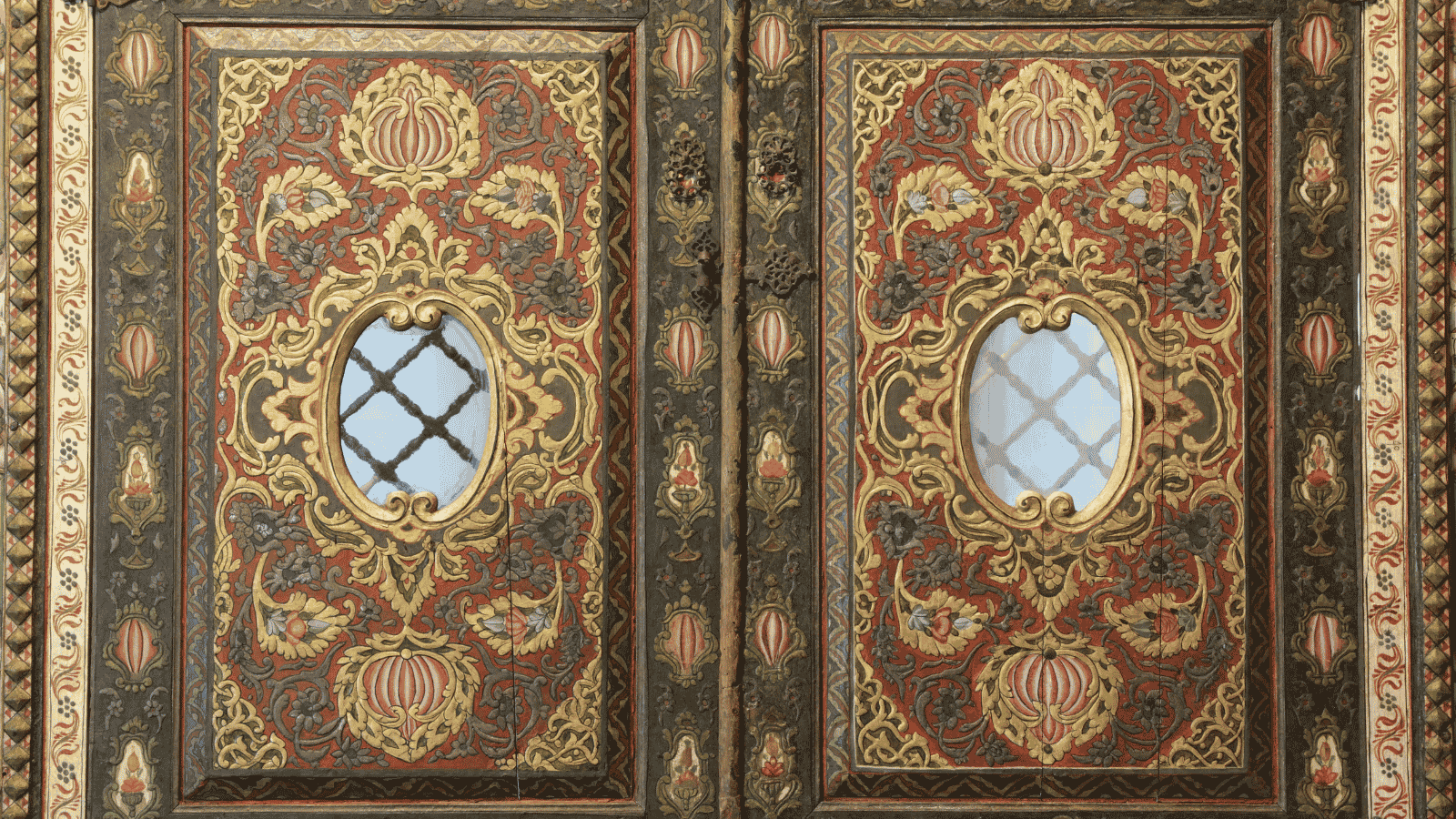
Explore Ajami, a decorative painting tradition developed in the lavishly painted interiors of Damascus, where raised ornament, colour and light shaped atmospheric architectural spaces. Its distinctive surface is built with nabati, a paste of gypsum and natural glue applied in relief, and brought to life through metal leaf, glazing and painted detail.
Drawing from these opulent interiors, this course takes students through the Ajami process, from raising a surface to finishing it in metal leaf and colour.
On a prepared wooden panel, students will practise relief, gilding, glazing and painting, working towards a piece shaped by this historic visual language.
Below is an overview of the week. Please note that this is subject to change, in response to the needs and progress of students on the course.
Day 1: The course opens with an introduction to Ajami through historic interiors and close-up surface details. The presentation will highlight the traditional colour palette and design language of Ajami, including floral motifs, borders and repeated decorative structures. Practical work begins with a demonstration of nabati relief, showing how the paste is applied by hand to create raised ornament. Participants will then shape wooden sticks into application tools before choosing from a range of pre-pounced traditional designs and transferring their selected pattern onto prepared, gessoed wooden panels. Participants will first practise on sample boards to become familiar with the material and develop control over line, pressure and build-up. They will then begin applying nabati to their final panels.
Day 2: Participants will begin by mixing Ajami primer for the next stage of the process. The primer will then be applied to the sample boards, allowing them to dry while participants continue work on their final panels. Participants will refine the nabati relief on their final panels, correcting edges and adjusting uneven areas. Individual guidance will be given throughout the day, with the aim of completing the raised ornament by the end of the day. The tutor will demonstrate how to prepare egg tempera binder and mix colours using pigment powder. Participants will prepare the binder, working within a limited colour palette drawn from Ajami interiors. Participants will test possible colourways on paper printouts of their chosen designs.
Day 3: A short film and visual presentation on historic Ajami interiors will introduce the scale, richness and visual impact of the tradition beyond the individual panel. The nabati on the final panels will have dried overnight, allowing the panels to be primed and set aside to dry. While the primer dries, the tutor will demonstrate gilding on a pre-prepared panel, showing how metal leaf is applied to raised nabati and how coloured glazes can be worked over gilded areas. Participants will practise gilding and glaze effects on their sample boards before moving on to their final panels as the surfaces become ready. By this stage, colourways and surface treatments will have been finalised, and participants will begin gilding their final panels.
Day 4: The focus will move to egg tempera and painted detail on the final panels. The day will open with a demonstration of outlining in enamel, after which the main technical demonstrations will have been covered, and the rest of the day will be used for guided work on each participant’s panel. Participants will complete the main gilding and coloured glaze areas before moving into colour and painted detail. The aim by the end of the day will be to bring each panel to a stage where only outlining, corrections and finishing remain.
Day 5: The final day will focus on outlining in enamel, corrections and finishing. Participants will complete painted details, sharpen edges, refine uneven areas and adjust any sections where the relief, gilding, glaze or colour need further work.
Individual guidance will focus on line quality, clarity of pattern and surface finish. By the end of the course, each participant will have worked a panel through the full Ajami sequence, and gained a practical understanding of how each stage builds on the last.
Key Information
Who is this workshop for?
All levels of ability and experience are welcome. You must be aged 18 or over to participate in our programmes.
How many people can attend?
14 people
What days/times do I attend?
Monday – Friday, 5 – 8 April 2027, 10:00 – 16:30
What materials do I need?
Please bring your own brushes. Your tutor suggests brushes for working with the different materials:
For enamel: A selection of brushes suitable for enamel paints, sizes 0–3, for detail work and fine outlining
For egg tempera:
– Filbert brushes, 1 each x sizes 1, 3 and 5 (see example)
– Pointed round sable brushes, 1 each x size 0 and 1 (see example)
Wear comfortable clothing that you do not mind getting slightly messy. Avoid wearing baggy clothing (especially sleeves), loose jewellery, high heels or open-toed shoes.
Where will this course take place?
This course will take place at our studios at The King’s Foundation School of Traditional Arts, 19-22 Charlotte Road, London EC2A 3SG.
FAQs
Do you offer concessions?
Yes, we offer concessions for Seniors/60+, full-time students and people who are unemployed/in receipt of benefits.
Concessions cannot be applied in retrospect. To receive a concession, please apply via our online form. We will then send you a discount code to use when booking your space.
Terms & Conditions
The School reserves the right to discontinue or suspend a Course up to fourteen (14) calendar days before the advertised start date of the Course. This course requires a minimum number of enrollments to run.
Our normal terms and conditions apply.
Tutor Biography
Amna Fraz is a visual artist drawn to how colour is held, built and transformed through surface. She trained in Ajami, a decorative painting tradition that flourished in the houses of Ottoman Damascus, where raised ornament was formed from gypsum and natural glue, gilded and painted in egg tempera. Having learned the technique under a Syrian master, her practice traces pigment and line through carefully prepared grounds. She carries this history forward into a visual language of her own.