About
Trees hold a special place in human life as a source of vitality and life force, known in Sanskrit as Prana. They sustain all living beings and support the entire ecosystem, or Samsara. Ancient Hindu and Buddhist traditions praise and venerate trees for their essential role in nurturing and sustaining life.
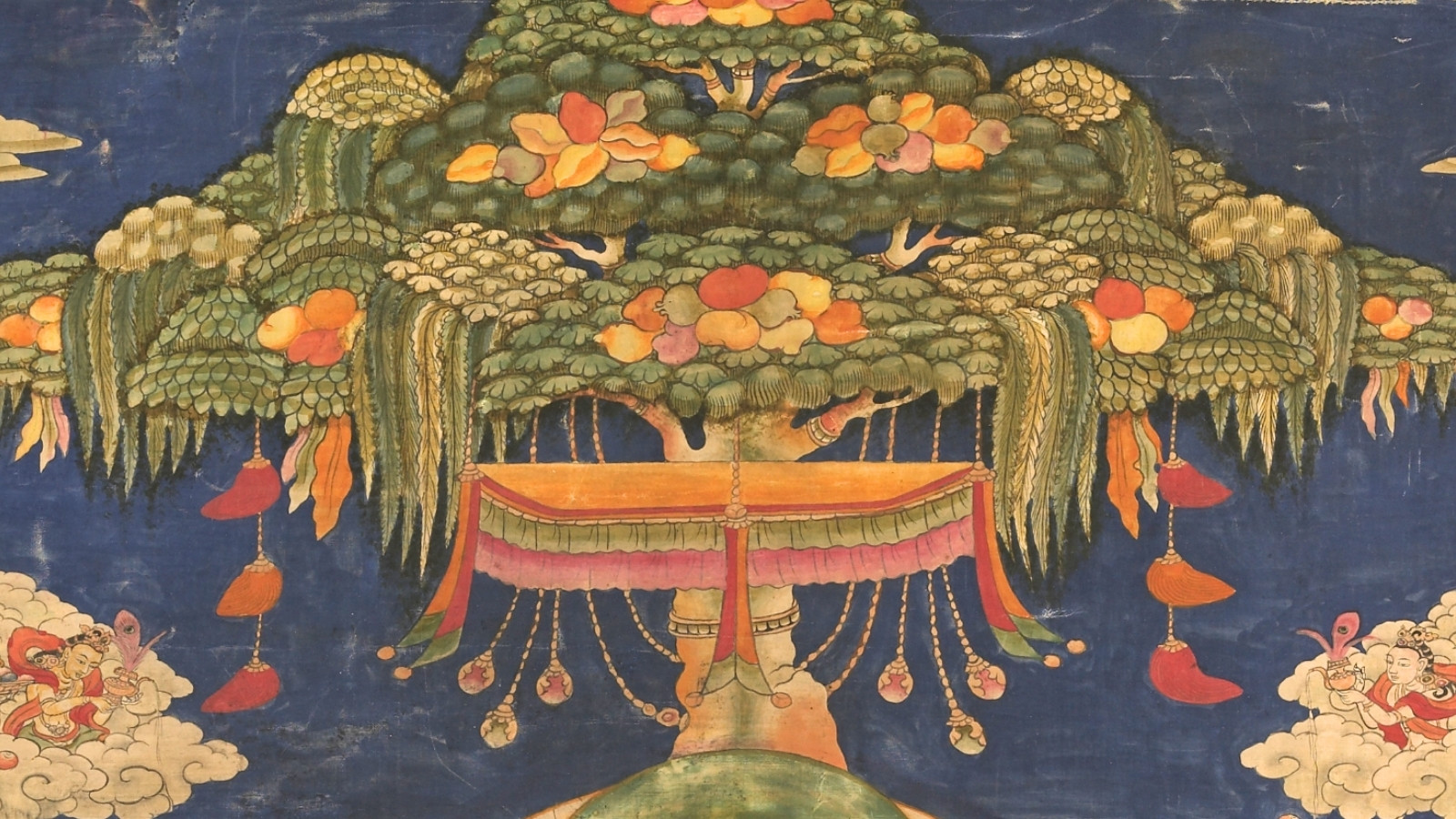
This course focuses on the sacred Kalpavriksha, also known as the Ratnataru, the wish-fulfilling tree that is believed to grant blessings and abundance to all living beings. A powerful symbol in Hindu and Buddhist cosmology, it represents prosperity, well-being, and the interconnectedness of life.
Inspired by the traditional Newari paubha painting tradition, students will explore the significance of trees in the art and culture of Nepal. They will learn how to draw, design, and paint their own Kalpavriksha or Ratnataru, creating a unique wish-fulfilling tree inspired by their imagination and creativity.
The course will introduce the techniques and methods of Paubha painting while exploring the philosophy, symbolism, and cultural meaning of the wish-fulfilling tree in Hindu and Buddhist traditions. By the end of the course, students will have gained an understanding of Paubha painting and completed a beautifully painted image of a wish-fulfilling tree that reflects their own creative vision.
Key Information
Who is this workshop for?
Students of all levels and experience are welcome.
You must be aged 18 or over to participate in our online programmes.
How many people can attend?
15 places are available.
What days/times do I attend?
Tuesdays, 11, 18, 25 May, 1, 8, 15, 22, 29 June, and 6, 13 July 2027, 10:00 – 13:00.
Times are given in British Summer Time (GMT+1).
How do I attend the online class?
This class will take place on Zoom, an online meeting platform. A link for joining the Zoom meeting will be in your confirmation email after booking.
What materials do I need?
- 1 x MDF board to stick your painting to, slightly larger than A4 size
- Several sheets of A4 size, cotton, hot-pressed watercolour paper, 300gsm
- Several sheets of A4 copy paper to practice on
- 1 x roll of masking tape or gum tape
- Graphite transfer paper, also called tracedown paper, wax free (see example)
- If you cannot find transfer paper, you can use carbon paper BUT you must be careful in using this as carbon can leave a strong mark on your paper.
- Pencils, erasers, sharpeners, ruler
- Black ink – either Chinese or Japanese ink from a bottle or stone. Walnut ink can also be used.
- Paintbrushes:
- Pointed round watercolour brushes, 2 x size 00000, 1 x size 000, 1 x size 1, 1 x size 3, 1 x size 6
- Wide, flat brushes, size 2 and 4
- A set of artist quality gouache or watercolours; If you cannot find gouache or watercolour, you can substitute with poster colours. Useful colours to have include: ivory black, white (any), cadmium yellow, yellow ochre, primary blue, indigo, cerulean blue, green (any), sap green, burnt sienna, burnt umber, cadmium red, and primary red. If you have any difficulty getting a particular colour, your tutor can guide you in mixing with what you have to hand.
- Water and a jar for washing your brushes
- A palette with wells
- Kitchen rolls to dry your brushes after use
- Optional: Shell gold or synthetic gold if you wish to use it.
If you are a returning student and have access to Nepalese paper, canvas and mineral pigments, you are welcome to use these during the course. This is optional.
Online Learning
What if I have questions during the workshop?
This will be a small workshop; Students will be able to ask questions via chat or unmute themselves.
Students will also have access to our online learning platform, Thinkific, where we share supplementary content.
I live in a different time zone, can I still attend?
We encourage you to attend the course in real time to really benefit from instruction; however, if you are unable to attend live due to the difference in time you can catch up via recordings on our online learning platform, Thinkific. These recordings are available for a limited time after the course.
Recordings cannot be purchased separately if the course is fully booked or if the course has already started.
Tips:
You must download the Zoom app and create a free account before the class begins, so that you can use the full range of features:
- You can create your free account here
- You can download the Zoom app onto your computer or device here
- You can create your free account here
FAQs
Do you offer concessions?
Yes, we offer concessions for Seniors/60+, full-time students and people who are unemployed/in receipt of benefits.
Concessions cannot be applied in retrospect. To receive a concession, please apply via our online form. We will then send you a discount code to use when booking your space.
What if I need to change or cancel my booking?
No refunds, unless cancelled by the School. If you cancel up to 1 week before the workshop starts, we can offer a transfer to another workshop of equivalent value, subject to availability.
Tutor biography
Renuka Gurung, PhD, learned Paubha painting from one of the Chitrakar Masters and Vajracharya priests of Nepal and has established herself as one of the leading masters of traditional Paubha painting. Following the completion of her doctoral studies at the School, Renuka continues her work of preserving Paubha painting by researching and documenting this traditional painting method. She travels internationally exhibiting her works, conducting workshops and lectures with the aim of introducing and promoting Paubha. She recently gave presentations and workshops on Paubha at the University of Oxford and in Hong Kong, and her paintings are in various private collections in Nepal, Russia, Italy, the USA and Britain.