
Tashkent – Uzbekistan
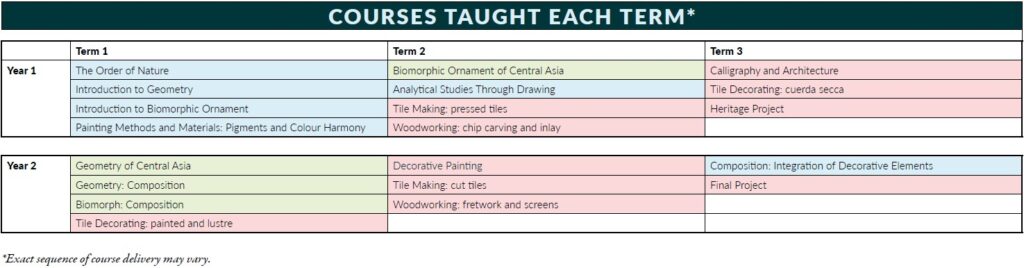
Developed in partnership with the Uzbekistan Art and Culture Development Foundation, the Naqsh School of Crafts offers a two-year Diploma Programme, with each academic year divided into three terms. The curriculum is structured around three interconnected thematic strands: the Order of Nature, the Design Language of Uzbekistan, and the Arts and Crafts of Uzbekistan.
Vision
The Naqsh School of Crafts is a collaboration between the Uzbekistan Art and Culture Development Foundation and The King’s Foundation School of Traditional Arts. The aim of this collaboration is the regeneration of the traditional arts of Uzbekistan and to support a living tradition that extends this heritage into the contemporary context. The Naqsh School of Crafts serves as a centre for the traditional arts of Uzbekistan in Tashkent, supporting this shared aim.
Through the study of Uzbekistan’s cultural heritage and an understanding of the universal principles of traditional arts, students are introduced to the language of traditional arts and architecture while gaining practical skills and design knowledge.
Diploma Programme
About the Programme
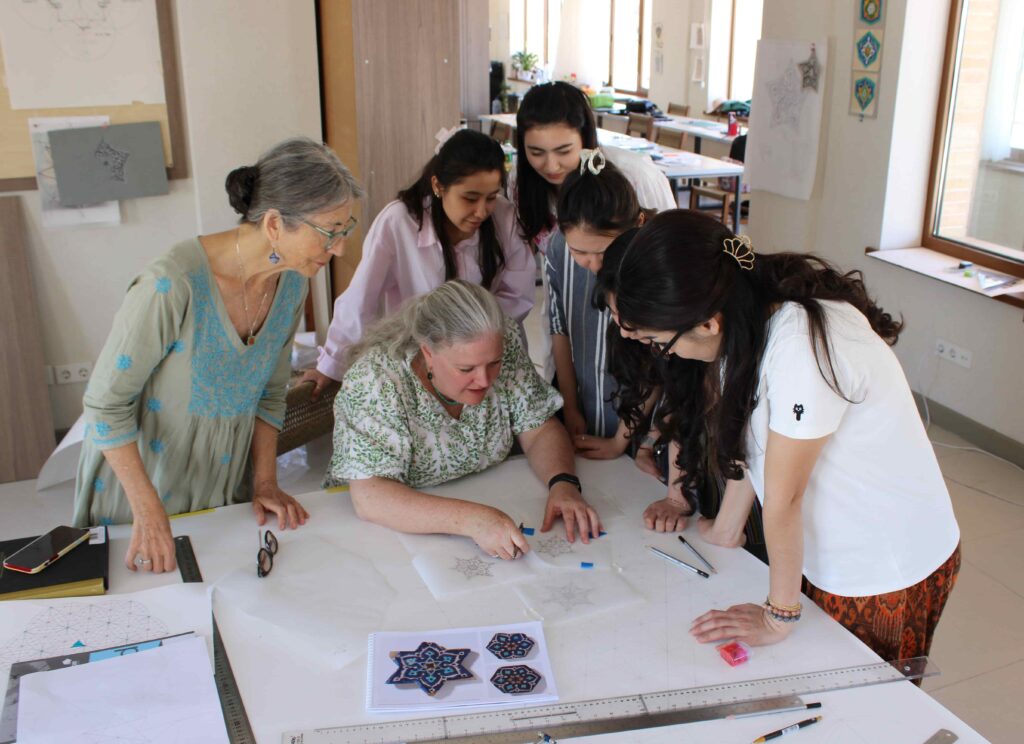
The programme is taught as a series of intensive practical modules employing a range of teaching methods designed to meet the needs of both established artists and beginners. It introduces students to the holistic process of traditional arts, integrating philosophical and theoretical study with practical and creative application.
At the beginning of each module, tutors provide an overview of its different stages, accompanied by illustrated introductory and contextual presentations. Teaching is primarily led by practical instruction and demonstrations of the skills involved in each craft or design process. Under the guidance of their tutors, students apply these demonstrations in their own practical work while keeping a course journal documenting the entire process through notes, sketches and photographs.
Discussion sessions between tutors and students take place throughout the programme to provide support and enable tutors to evaluate students’ developing skills and the body of work they produce. Teaching methods also include individual tutorials and supervised workshop activities.
At the end of the first year, students undertake the “Heritage Project,” an introductory design and craft project that enables them to apply the knowledge and skills developed throughout the design and craft modules. During the second year, students progress to more complex individual and collaborative projects based on the architectural masterpieces of Uzbekistan.
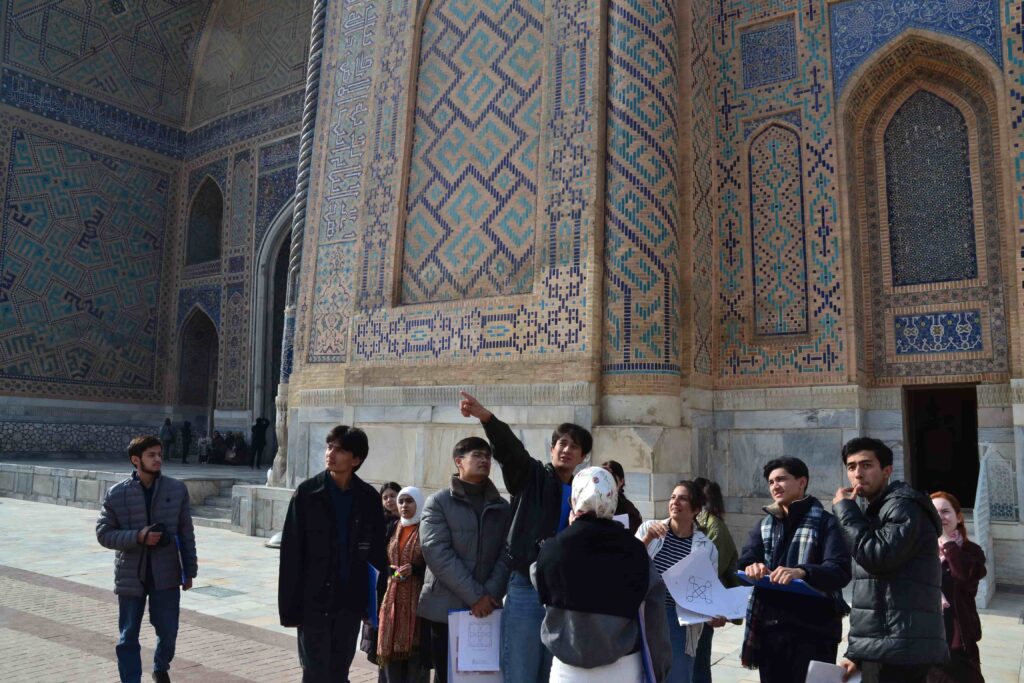
Field study visits form an integral part of the programme, providing students with the opportunity to engage directly with the context of traditional architecture. These visits help students understand how the arts and crafts are intrinsically connected to a wider cultural and architectural context, while strengthening the relationship between theory and practice. Through on-site observation, sketching, note-taking, lectures and seminars, students gain first-hand insight into the intentions, methods and achievements of master artisans and builders.
Modules of Study
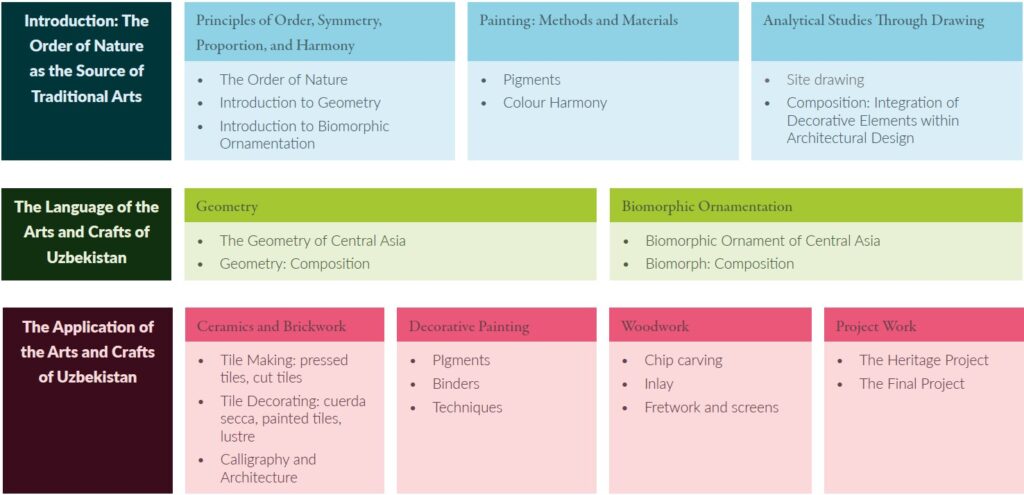
The curriculum is organised into three core modules:
- Introduction: The Order of Nature as the Source of Traditional Arts
- The Language of the Arts & Crafts of Uzbekistan
- The Application of the Arts & Crafts of Uzbekistan
Together, these modules form the foundation of the curriculum and are woven throughout the two-year programme to support students in their learning journey.
Module 1. Introduction: The Order of Nature as the Source of Traditional Arts
An understanding of the order of nature lies at the heart of all traditional arts. It is evident in the forms, structures and creative processes of the natural world, embodying the principles of geometry, proportion, symmetry and harmony that are fundamental to the study of arts and crafts. These principles form the basis for understanding form, materials and design.
The main themes that will be investigated include:
- The order of nature
- The language of geometry and ornamentation
- Symmetry groups
- Proportions: polygons and rectangles
- Spirals and curves
- The essence of form: stylising leaves and flowers
- Creative design principles: hierarchy, elegance, balance, symmetry, proportion, context
- Methods and materials: pigments from nature, introduction to colour harmony
- Architectural analysis and design principles
Module 2. The Language of the Arts & Crafts of Uzbekistan: Geometry & Biomorphic Ornamentation
The extraordinary beauty of the traditional arts of Uzbekistan is especially notable in the designs that ornament its architecture, ceramics, painting and decorative arts. While emerging from principles universal to Islamic art, the geometric and floral patterns also express a visual language shaped by the cultural context of Central Asia. Through this module, students will study and learn from the unique pattern language of Uzbekistan.
This module focuses on the language and form of the arts of Uzbekistan through the study of:
Geometry
- Design with proportions: relationships and rectangles
- Central Asian contributions to the geometric pattern language
- Brick patterns
- Proportional systems of arches and domes
Biomorphic Ornamentation
- Composition: combining motifs and spirals, designing in relationship to shape
- Biomorphic design: analysis of specimen patterns and regional variations
- Composition for architectural context: panels, spandrels, domes
Module 3. The Application of the Arts & Crafts of Uzbekistan: Decorative Painting, Ceramics, Woodwork
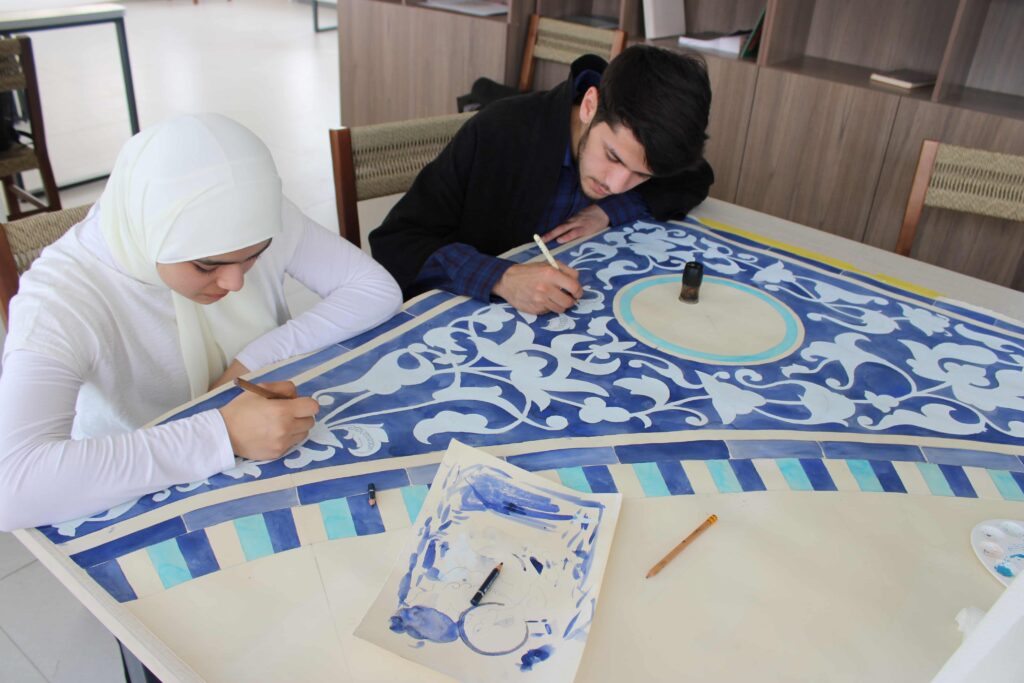
The painting component focuses on the architectural context, introducing students to the materials and processes of wall painting. Building on the understanding of pigments and colour harmony developed in the introductory modules, students explore the techniques and binders suitable for architectural applications.
- Methods and materials (glue, egg tempera, casein)
- Wall painting techniques
The ceramic courses investigate both tile making and tile decoration. Students also explore the harmonious combination of glazed tiles and brickwork through panel design projects that bring together multiple techniques within single projects.
- Tile making: pressed, cut tiles
- Tile decorating: cuerda seca, hand painted tiles and lustre
- Calligraphy and Architecture: integrating different techniques of tiles and bricks
Techniques of woodworking focus on the decorative skills of carving, inlay and simple pieces joined to create lattice screens.
- Decorative Carving (chip carving)
- Fretwork
- Inlay
Who is the Programme for?
The programme is designed for artists, researchers, and craftspeople, equipping them with a balance of theoretical knowledge and practical skills. Through an accredited Diploma Programme, students receive vocational and design training that prepares them to become proficient designer-makers while engaging with the decorative and building arts and crafts.
Admission Requirements
This is a full-time, two-year Diploma Programme that requires students to attend on a daily basis.
Normal teaching hours are from 9:00 am to 5:00 pm.
Admission is by interview, and applicants should demonstrate their skills, experience and interest in the field through a portfolio of work.
Applying
Applications are now open for the first cohort of the Naqsh School of Crafts’ full-time Diploma Programme, commencing this autumn.
Apply Here: https://www.naqshschoolofcrafts.uz/en/diploma
Applications close on Friday 28 August 2026.
Partner
The Uzbekistan Art and Culture Development Foundation (ACDF) preserves, promotes and nurtures Uzbekistan’s heritage, arts and culture. Founded in 2017, ACDF drives the country’s cultural ecosystem and creative economy, creating opportunities for practitioners locally, regionally and globally.
To date, ACDF has reached over 5 million visitors through landmark exhibitions worldwide, with projects in more than 17 countries and collaborations with over 40 international institutions — including the Louvre and Arab World Institute in Paris, the Uffizi in Florence, the British Museum in London and the Palace Museum in Beijing.