
About
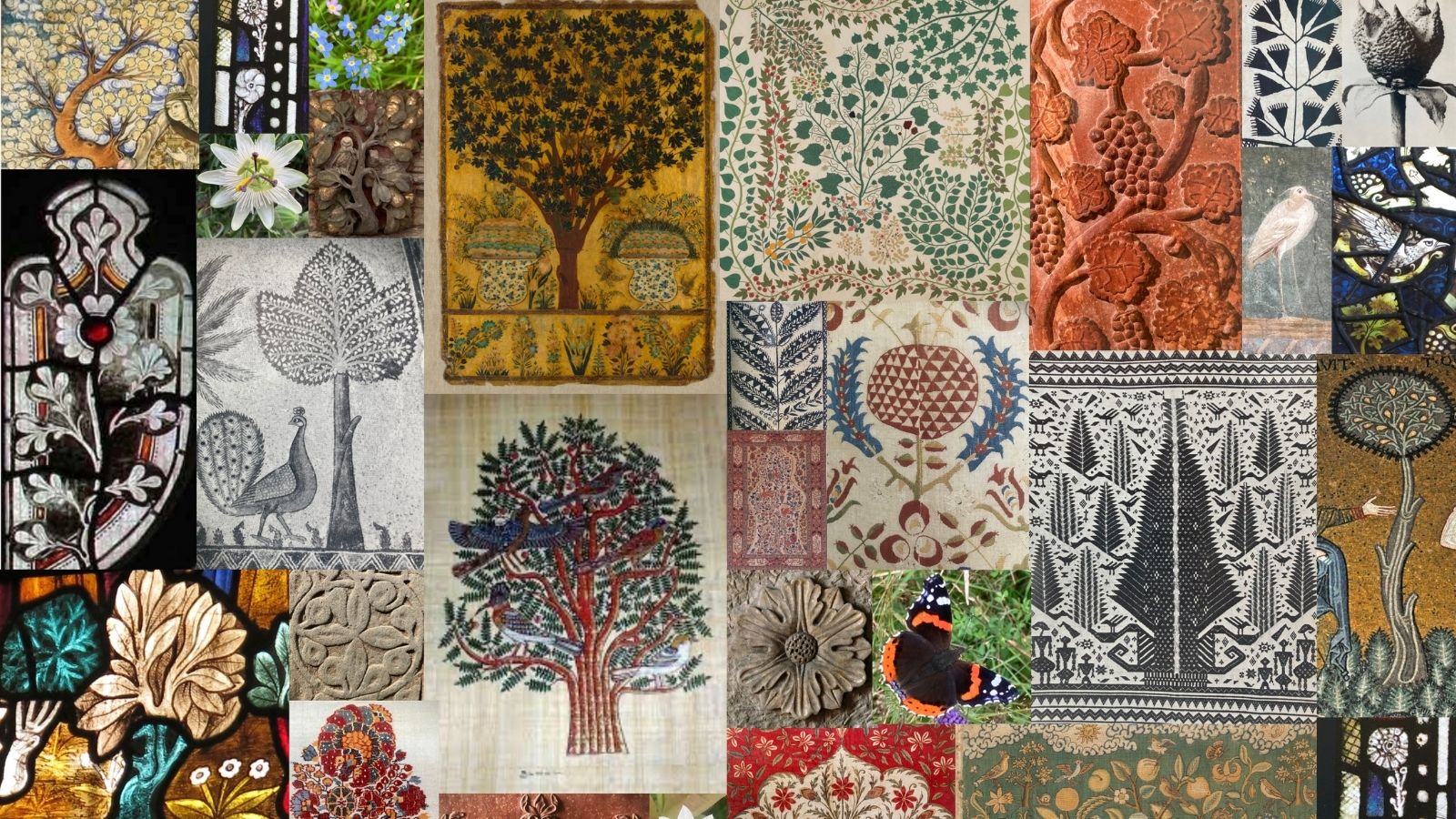
Since the beginning of our shared human existence we have created myths and stories to understand our world. The tree universally symbolises the vertical axis which connects the underworld, the earthly world of man and the heavenly realms above. The Tree of Life is a fundamental universal archetype which takes form in different mediums in art across the world.
During this week‑long course, participants will explore the symbolism of the Tree of Life across different cultures. Each person will then create their own interpretation of this symbol—either from imagination or inspired by a collection of images. These may include birds, insects, animals, leaves, flowers, or various plant and tree forms. References can come from photographs, sketches, or ancient artworks. The Tree of Life design may be simple or visually intricate, depending on what each participant prefers. Museums, books, and Islamic rugs are all excellent sources of inspiration. The tutor will also provide a few ready‑made designs for anyone who prefers not to create their own from scratch.
When developing their designs, participants should keep in mind the practical requirements of painted stained glass. The technique has particular constraints that need to be considered so that the artwork translates effectively into the medium. The final glass panel will be approximately 30 × 30 cm, though it may be square or rectangular depending on what best suits the composition.
The week begins with an illustrated introduction to the symbolism of the Tree of Life, followed by time for participants to develop their own designs and map out the necessary glass‑cutting lines. Once designs are finalised, the next stage is cutting the glass pieces that will form each panel. This is followed by the first round of painting, starting with the trace line and some initial tonal work, after which the pieces are fired in the kiln. The following session continues with additional layers of painting, and, if time allows, the application of silver stain to achieve a transparent golden yellow on white glass. The week concludes with leading the panels, soldering, cementing, and attaching hanging hooks to complete the finished artwork.
Key Information
Who is this workshop for?
All levels of ability and experience welcome. You must be aged 18 or over to participate in our programmes.
How many people can attend?
8 people
What days/times do I attend?
Monday – Friday, 17 – 21 August 2026, 10:00 – 16:30
What materials do I need?
- Ideas: There will be only one day dedicated to completing the initial drawing, so arriving with ideas—or even a preliminary sketch—would be very helpful.
- Students are asked to bring their own brushes:
- 1 x Chinese brush (see example)
- 1 x Filbert brush, size 6 (your tutor recommends the Handover Synthetic Sable)
- 1 x Pointed round, size 6 (your tutor recommends the Davinci Nova Lettering Series 1270)
- 1 x Flat watercolour brush, 1/4 inch (Jackson’s Icon Watercolour Brush Flat Series, red sable)
- 1 x Small pointed round, size 4 (Handover synthetic sable)
- 1 x Pointed writer brush, size 1 or 2 (Handover sable pointed writer series 2113)
- 1 x Long flat brush, 3/4 – 1 inch (Daler Rowney System 3 Acrylic Brush)
All other materials will be provided.
Wear comfortable clothing that you do not mind getting slightly messy. Avoid wearing baggy clothing (especially sleeves), loose jewellery, high heels or open-toed shoes.
Where will this course take place?
This course will take place at our studios at The King’s Foundation School of Traditional Arts, 19-22 Charlotte Road, London EC2A 3SG.
FAQs
Do you offer concessions?
Yes, we offer concessions for Seniors/60+, full-time students and people who are unemployed/in receipt of benefits.
Concessions cannot be applied in retrospect. To receive a concession, please apply via our online form. We will then send you a discount code to use when booking your space.
Terms & Conditions
The School reserves the right to discontinue or suspend a Course up to fourteen (14) calendar days before the advertised start date of the Course. This course requires a minimum number of enrollments to run.
Our normal terms and conditions apply.
Tutor Biography
Naomi Preston gained an MA at The King’s Foundation School of Traditional Arts with a particular interest in Celtic/Pictish Art. Originally coming from a background in Fine Art Printmaking – primarily etching, Naomi’s early interest in light and dark, shape and colour, attracted her to study traditionally painted stained glass in her final MA year with theSchool. This laid the foundation for an apprenticeship in the glass painting workshop of a large stained glass company.
Currently based in Aberdeenshire, she has continued with working primarily in painted stained glass. She has a strong interest in ancient symbolism and the universal language of pattern and geometry and explores these themes in her work.