
Exhibition: The Sacred & the Sublime
Form, Formlessness and Sacred Space
Exploration Through Arts Practice
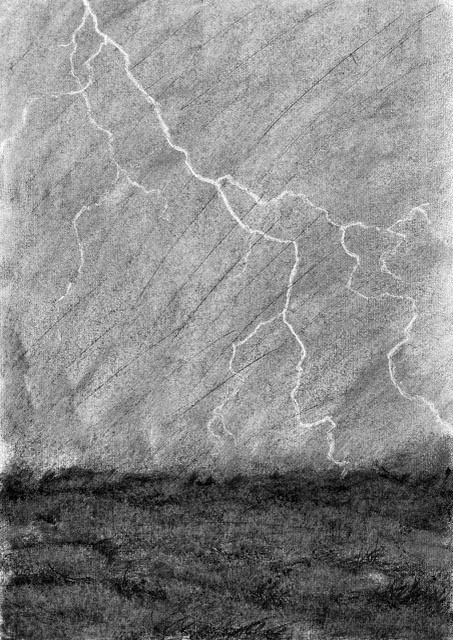
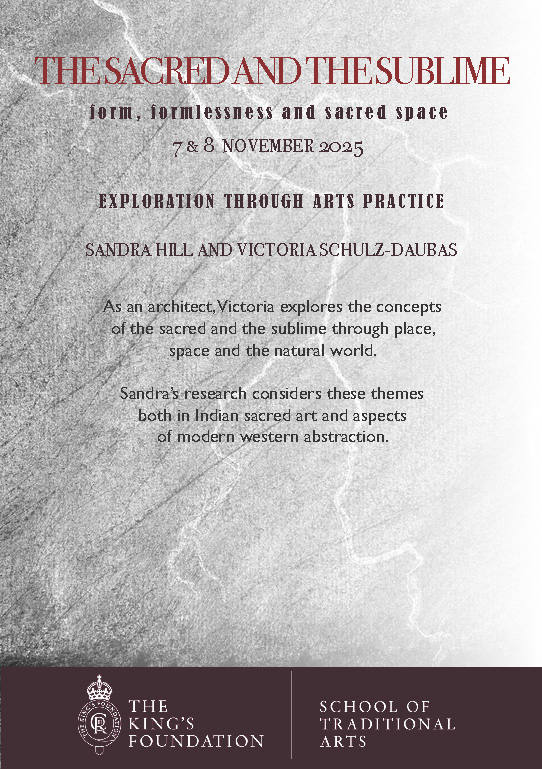
Works by Sandra Hill and Victoria Schulz-Daubas
As an architect, Victoria explores the concepts of the sacred and the sublime through place, space and the natural world.
Sandra’s research considers these themes both in Indian sacred art and aspects of modern Western abstraction.
Entrance is free, but booking is required.
Each session includes a talk by the artists.
Ticketed Entrance Times
| Date | Time |
| Friday 7 November | 18:00 – 19:30 |
| Saturday 8 November | 11:00 – 12:30 14:00 – 15:30 |
Venue
The Library at
The King’s Foundation School of Traditional Arts
19-22 Charlotte Road, London EC2A 3SG
Exhibition Brochure
Victoria Schulz-Daubas
Victoria Schulz-Daubas is an architect and researcher whose work explores how architecture can give form to experiences of awe and transformation. She studied at the Technische Universität München, Queen’s University Belfast, and the University for the Creative Arts, and is currently completing a PhD at The King’s Foundation School of Traditional Arts in London.
Her doctoral research, Sublime Design: (Re)-capturing the Sublime in Architecture, interprets the philosophical idea of the sublime as a catalyst for contemporary architectural thinking. It argues that cultivating the sublime within the built environment may help renew relationship with the world at a time of ecological and social strain.
Created as a part of fieldwork, the charcoal drawings shown here trace brief instants where light and landscape evoke moments of sublime encounter.
Artist’s Statement
My research and drawings explore how the sublime might inform architecture — not as style or spectacle, but as a way of thinking and perceiving that can reconnect us with meaning, humility, and imagination. The sublime, as first expressed by the ancient author Longinus,
speaks of those rare moments when we are carried beyond ourselves by something greater:
a mountain, a storm, a force of nature. They are glimpses of what Longinus described as “a welltimed flash of sublimity” — brief, transformative encounters in which we feel the world as an archaic presence that changes how we see and how we build.
In the mountains, where light breaks through after thunder or a ridge stands clear against open sky, I look for that threshold between fear and wonder. Charcoal — an elemental medium born of fire — becomes a fitting instrument for what resists capture: it smudges, fades, and leaves traces rather than outlines, much like the experiences it seeks to express.
For me, the sublime is not only an aesthetic category but a moral one. As Emily Brady observes, sublime sensibility can “feed into moral perceptiveness.”
To encounter something vast and beyond control is to be reminded of our limits — yet also of our capacity for empathy and renewal.
“A well-timed flash of sublimity scatters everything before it like a bolt of lightning.”
– Longinus, On the Sublime
“As sublime sensibility is developed, we can expect this perceptiveness to feed into moral perceptiveness.”
– Brady, The Sublime in Modern Philosophy
Sandra Hill
Sandra studied Fine Art at the University of the Arts Central St Martins, and completed postgraduate studies at Chelsea College of Art. She lived for several years in both South and East Asia. Sandra completed her research at KFSTA in March 2025.
The research focused on the non-figurative traditions of Indian sacred art, which she explored in relation to her contemporary arts practice
THE NO-FORM ABSOLUTE
Within the Saivite Hindu traditions, Śiva represents the formless Absolute. In Śiva temples, the deity is found at the centre of the temple in the form of an ovoid, often black, stone, the Śiva linga. In painting, Śiva can be seen in the black ovoid of the no-form Absolute. This image, in combination with the triangle of primary manifestation, became a focus of my practical research. In the figurative image above, I have followed tradition by using cinnabar pigment, which is a chemical compound of mercury and sulphur, and alludes to alchemical transformation.
Artist’s Statement
My PhD research, Approaching the Formless: the non-figurative art of the Hindu traditions
and its relevance to a contemporary arts practice, explores the ritual art of Hinduism through its making – following its traditional methods, materials and processes. I considered how images of the formless Absolute relate to a sense of awe, which is described within the Indian traditions according to the concepts of rasa (aesthetic experience), or samvega (aesthetic shock), which is traditionally compared to a lightening strike. I questioned whether a minimalist ‘lack of signifiers’ within non-figurative imagery allows a more immediate relationship with the work itself; a relationship which enables experience without commentary and interpretation, and encourages an immersive embodied relationship with the image.
The absolute …is incomprehensible to the mind, cannot be expressed by words. It has neither
name nor colour… it is immeasurable, propless, unchanging, formless, without attributes,
perceptible to Yogins, all-pervasive, and the sole
cause of the universe.– Śiva Purāṇa
The Beautiful in nature is connected with the
form of the object, the Sublime is to be found in
a formless object, so far as in it, or by occasion of
it, boundlessness is represented.– Kant, Critique of Judgement