About
Oléo Films & Mad Minute Music, with support from the Aga Khan Music Programme & SACEM, TV5Monde, & Mezzo, present:
BALLAKÉ SISSOKO, KORA TALES
BALLAKÉ SISSOKO, UNE HISTOIRE DE KORA
53” documentary film
Written and directed by Lucy Durán and Laurent Benhamou, 2023
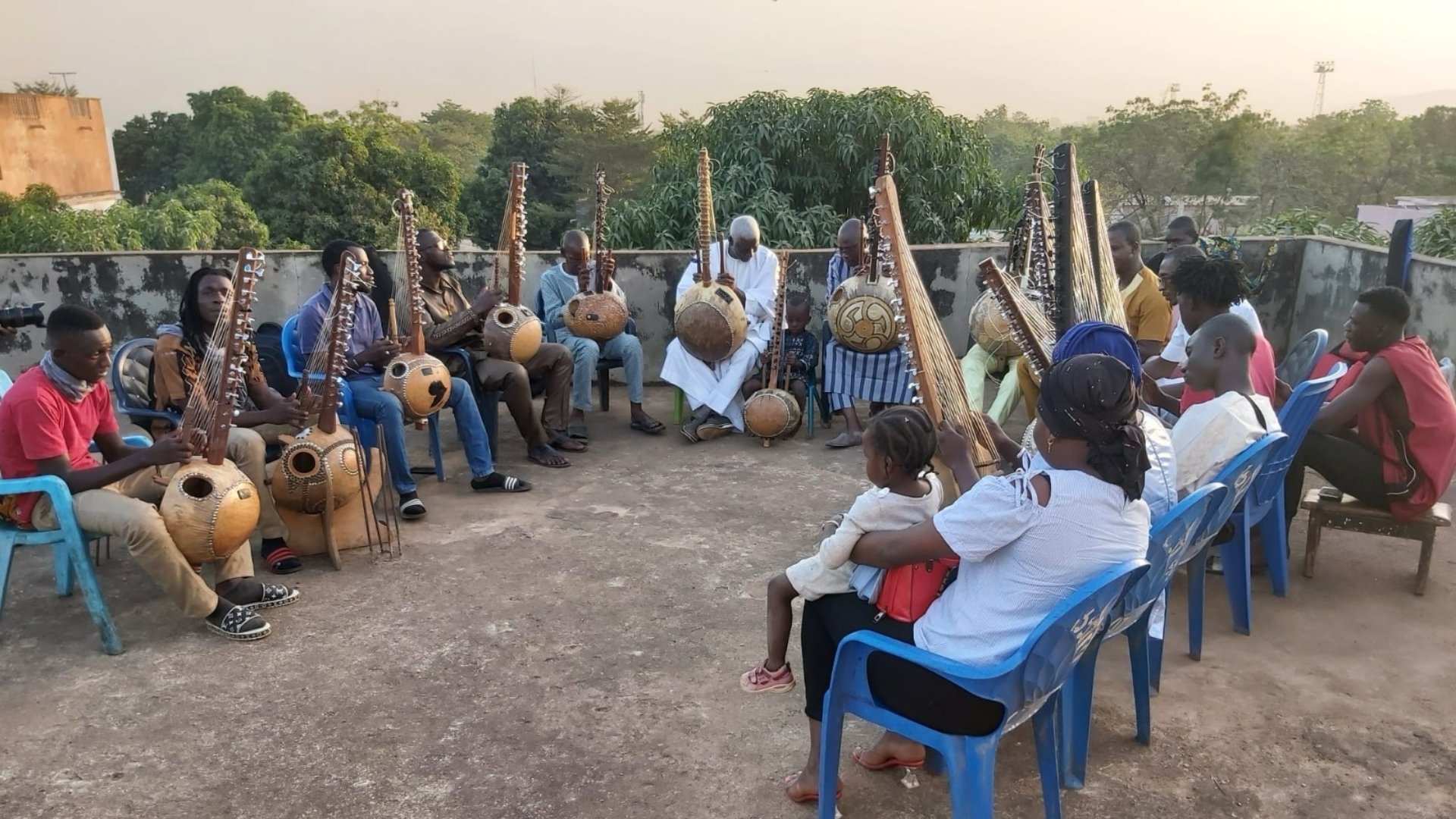
World-renowned, award-winning Malian musician Ballaké Sissoko takes us on an unprecedented journey to follow the trail of his instrument, the kora, a West African 21-string harp whose origins are surrounded by legend. Shot on location, the journey begins at Ballaké’s home in Bamako, capital of Mali where he was born and raised. We hear his talented group of young kora students play sublime music on his rooftop, songs he has taught them from the traditional repertoire of his father, who was from Gambia but settled in Mali in the 1960s, early years of its independence.
Ballaké’s cousin demonstrates the complex craft of making a kora, and takes Ballaké for the first time to visit the majestic rocky hills where the great Mali empire began.
Travelling further westwards to Senegal and Gambia, to his ancestral homeland, Ballaké traverses by canoe the beautiful Casamance river to drop in on a family of kora players who keep alive the old traditional style of the instrument. Inspired, Ballaké plays the kora late into the night, to the sounds of crickets and night birds, on his way to visit a sacred location where according to myth, the kora was first invented by invisible spirits, the djinns.
Narrated by celebrated Malian rapper Oxmo Puccino, this film takes us for the first time to the heart of the kora tradition, and to the mystique and legend around it.
Language: Bambara, Mandinka, French. With English subtitles.
Key Information
Who is this lecture for?
All are welcome.
How do I attend?
This event will take place in person at The King’s Foundation: School of Traditional Arts, 19-22 Charlotte Road, London EC2A 3SG
Please note this lecture will not be recorded.
What days/times do I attend?
Wednesday, 4 February 2026, 18:30 – 20:30
FAQs
Do you offer concessions?
Yes, we offer concessions for Seniors/60+, full-time students and people who are unemployed/in receipt of benefits.
Concessions cannot be applied in retrospect. To receive a concession, please apply via our online form. We will then send you a discount code to use when booking your space.
Terms & Conditions
The School reserves the right to discontinue or suspend a Lecture up to fourteen (14) calendar days before the advertised start date. This lecture requires a minimum number of enrolments to run.
What if I need to cancel or change my booking?
No refunds or cancellations, unless cancelled by the School.
Our normal terms and conditions apply.
Biography
Lucy Durán (PhD SOAS, BMus & MMus King’s College, London) is Professor Emerita of Music in the Department of Music, SOAS University of London. Her main regional interests are in West Africa and Cuba and she has contributed widely to promoting knowledge of these traditions not just through academic research but also through media output, with award-winning albums and documentary films. She established pioneering modules of both Cuban music and Mande music at SOAS, the first of their kind in the UK. She has been researching music in Gambia, Senegal, Guinea Bissau, Guinea, Mali and Cuba for over four decades, and is widely published in academic journals.
Apart from her academic research and teaching, Lucy has a long career as a radio broadcaster on BBC Radios 2,3,4 and World Service from 1987-2013. She was the regular presenter of World Routes, BBC Radio 3’s flagship world music programme, for the duration of its life on air (2000-2013). This involved researching and recording music on location in over forty countries including Cuba, Bolivia, Madagascar, Mali, Equatorial Guinea, Azerbaijan, Cape Verde, Senegal, Mali and Guinea Bissau, which gave her first-hand insight into the changing contexts of music of oral transmission.